CameraEditor: Camera-Controlled Image Editing via Video-Prior Sequential Modeling

Xin Shen1,* Chengyou Jia1,* Keshuo Xing1 Zifeng Zhu1 Changliang Xia1 Bowen Ping1 Zhuohang Dang1 Hangwei Qian2 Minnan Luo1,†
1Xi'an Jiaotong University 2A*STAR
* Equal contribution † Corresponding author
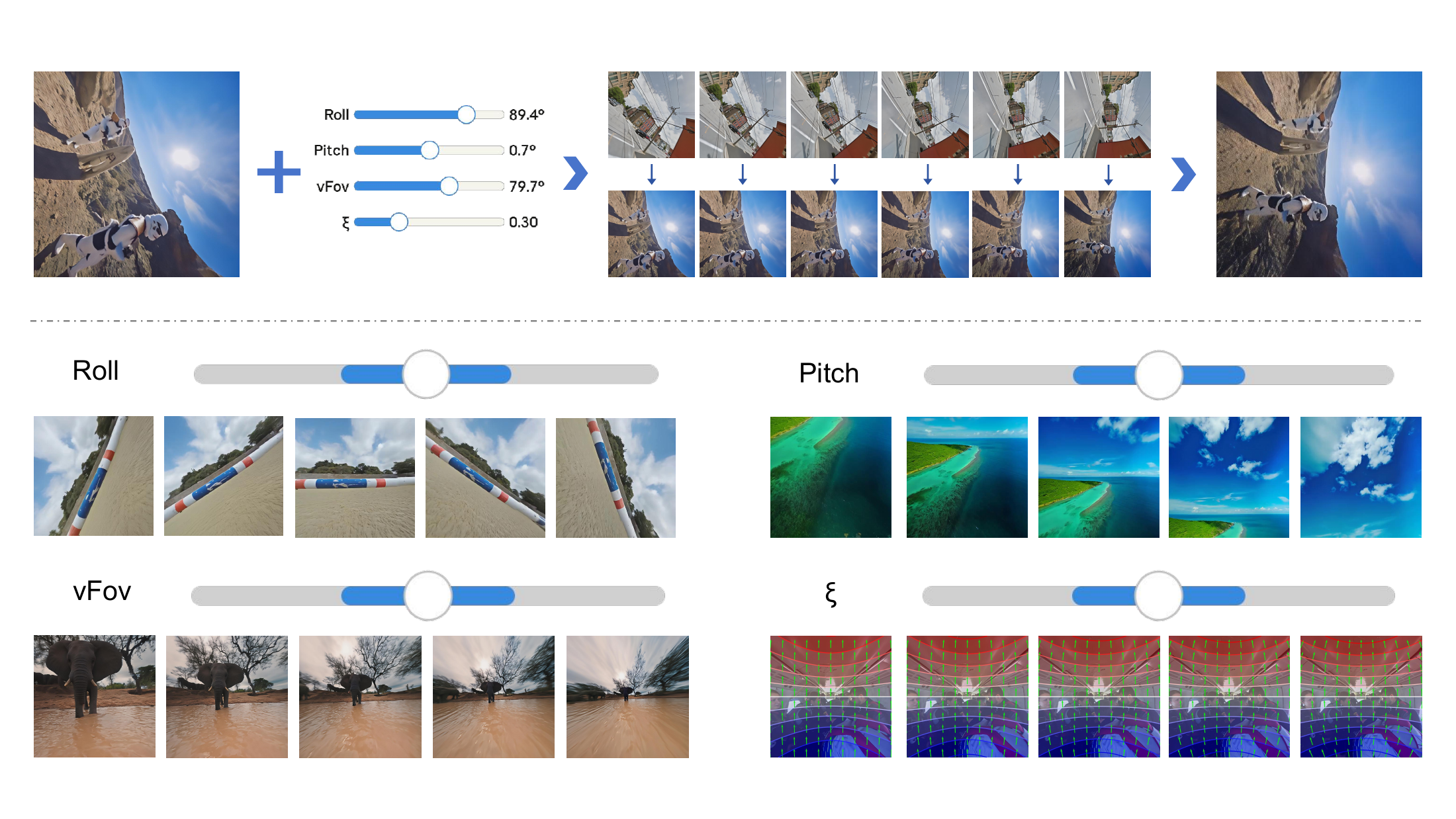
CameraEditor edits showing controlled camera transformations

CameraEditor provides explicit control over camera extrinsics and intrinsics while preserving source identity.

Abstract

Beyond semantic content, camera parameters play a pivotal role in dictating the geometric perspective and appearance of any given image. While recent image editing models excel at semantic and stylistic manipulation, they struggle with explicit camera parameter control. When handling large perspective shifts, instruction-driven models face a dilemma: they either suffer from structural tearing or generate conservative outputs that ignore geometric instructions. To address this, we introduce CameraEditor, a framework that reformulates camera-controlled editing from a spatial problem into a temporal sequence prediction task. By leveraging the temporal coherence of video diffusion models, our approach integrates an explicit geometric perception module with a dynamic reference routing mechanism. This allows us to construct geometrically rigorous visual reference pairs via dynamic panorama cropping, overcoming the ambiguity of text-based instructions. Furthermore, CameraEditor strategically inserts intermediate transition frames to decompose large perspective shifts, providing a robust temporal buffer that preserves content identity and spatial coherence. We construct a training dataset of 5,760 instances and introduce CamEditor-Bench, an evaluation suite of 462 test cases. Extensive experiments demonstrate that CameraEditor achieves state-of-the-art camera control precision and source identity preservation.

Video Result

Method

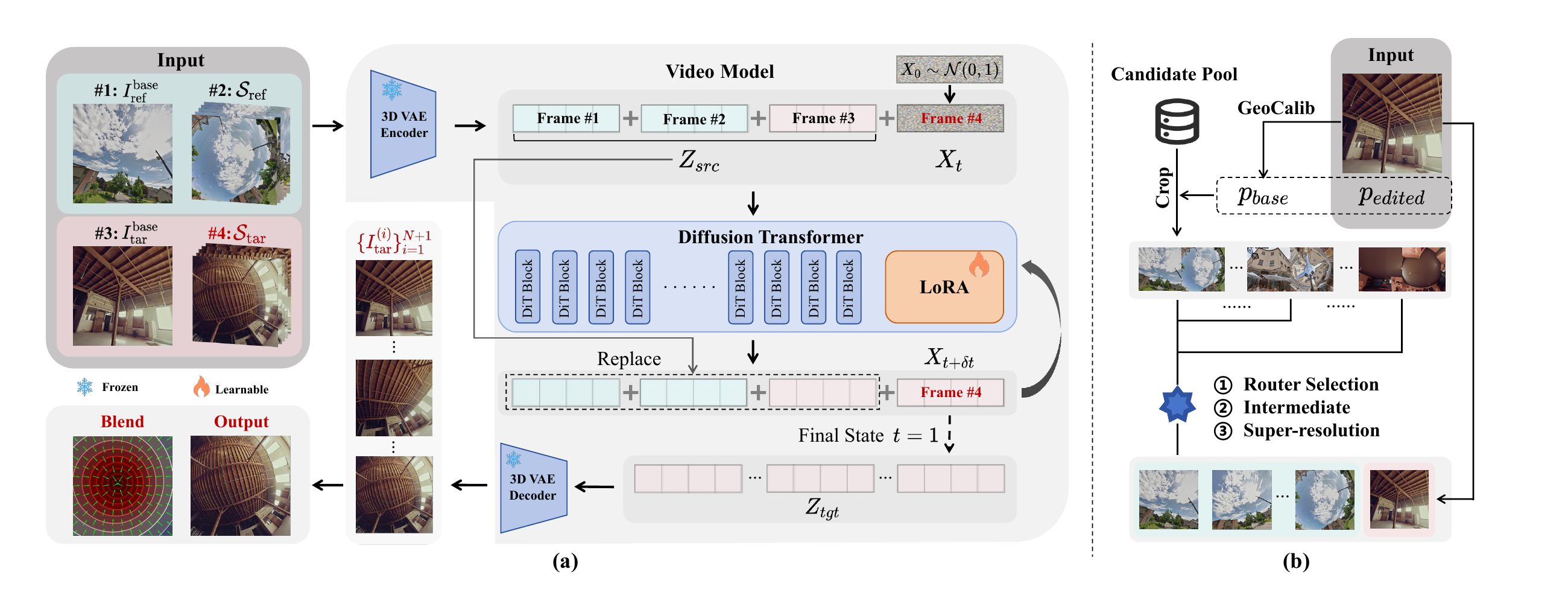
CameraEditor architecture
CameraEditor reformulates camera-controlled image editing as temporal sequence prediction. Explicit geometric perception and dynamic reference routing provide accurate camera conditioning, while Chain of Frames decomposes large transformations into stable intermediate steps.
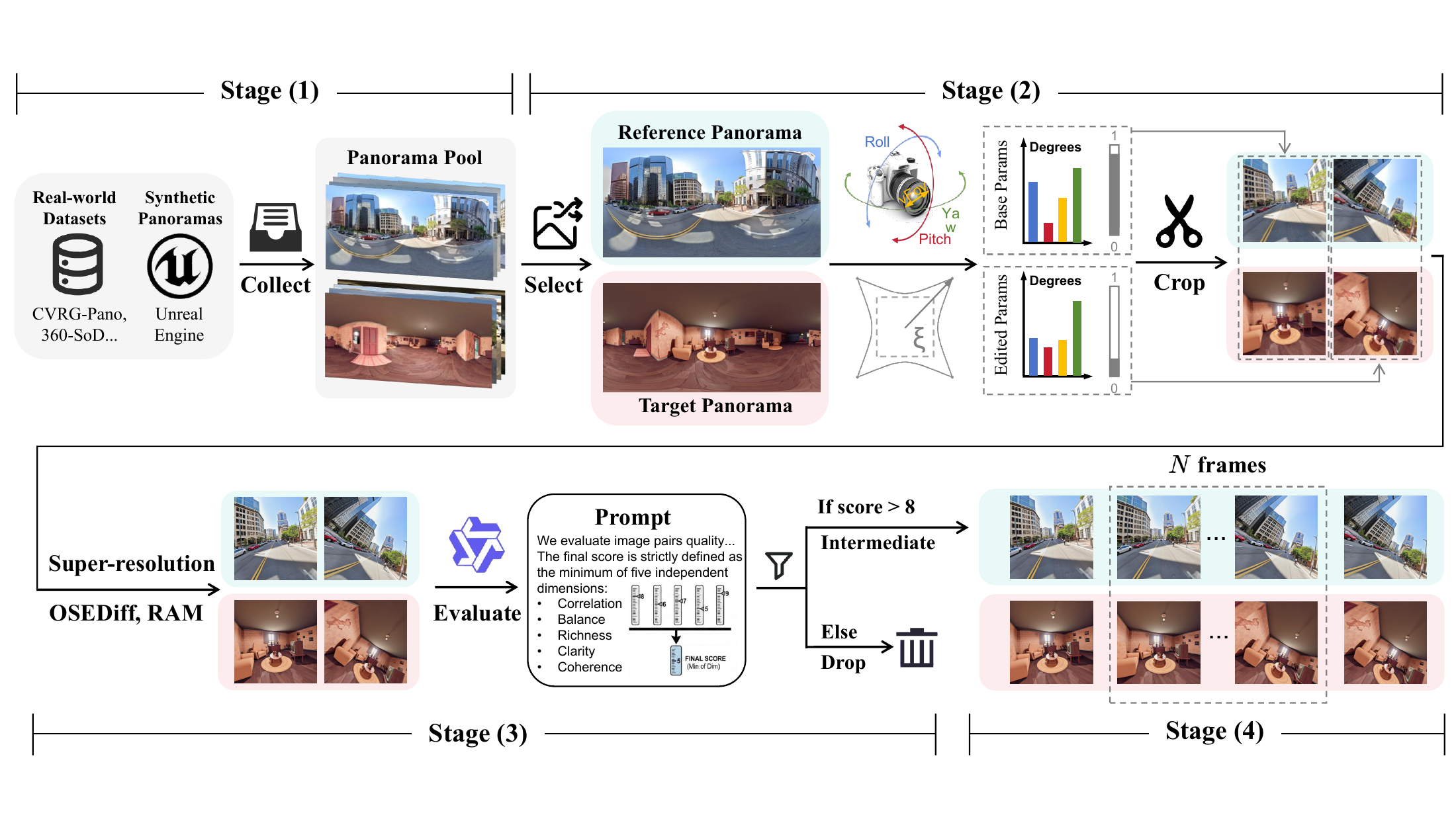
CameraEditor dataset generation pipeline
Dataset generation pipeline. Camera-aligned pairs are cropped from real-world and UE5 panoramas, enhanced, filtered, and interpolated into temporal training sequences.

Results on CamEditor-Bench

All controlled variants use the same Wan2.1-T2V-14B backbone for a fair comparison.

Method Setting Reference-based Reference-free
DINO-v2 ↑ CLIP-I ↑ SSIM ↑ LPIPS ↓ CLIP ↑ FID ↓ ImageR ↑ DreamSim ↓
ICEditβ€”0.70890.80090.37400.71610.87170.20320.51290.2928
Step1X-Editβ€”0.76750.85020.41410.68380.86800.20610.51680.2972
OmniGen2β€”0.66160.80410.36300.67740.87490.20290.51200.2937
FLUX.2β€”0.76040.85670.41730.63970.88060.18430.52950.2710
Qwen-Image-Editβ€”0.77490.87230.44280.63450.89230.17120.53540.2549
HunyuanImage-3.0β€”0.77620.84170.39910.65510.86950.19100.52000.2816
GPT-Image-1.5β€”0.77030.84160.44690.64600.85240.20390.51530.2801
Nano-Banana-Proβ€”0.77690.86420.45430.64400.85660.21360.51590.3020
Wan2.1-T2V-14BNo Ref.0.69510.82350.49660.63800.88370.20910.53590.2802
Wan2.1-T2V-14BPlΓΌcker0.76170.86520.51390.63400.91860.17510.55360.2575
CameraEditorOurs0.85690.89700.57120.54540.92670.09170.60890.1904

Human Preference

ComparisonPreference for CameraEditor
vs. Step1X-Edit82.0%
vs. Qwen-Image-Edit63.5%
vs. Nano-Banana-Pro69.5%

Qualitative Results

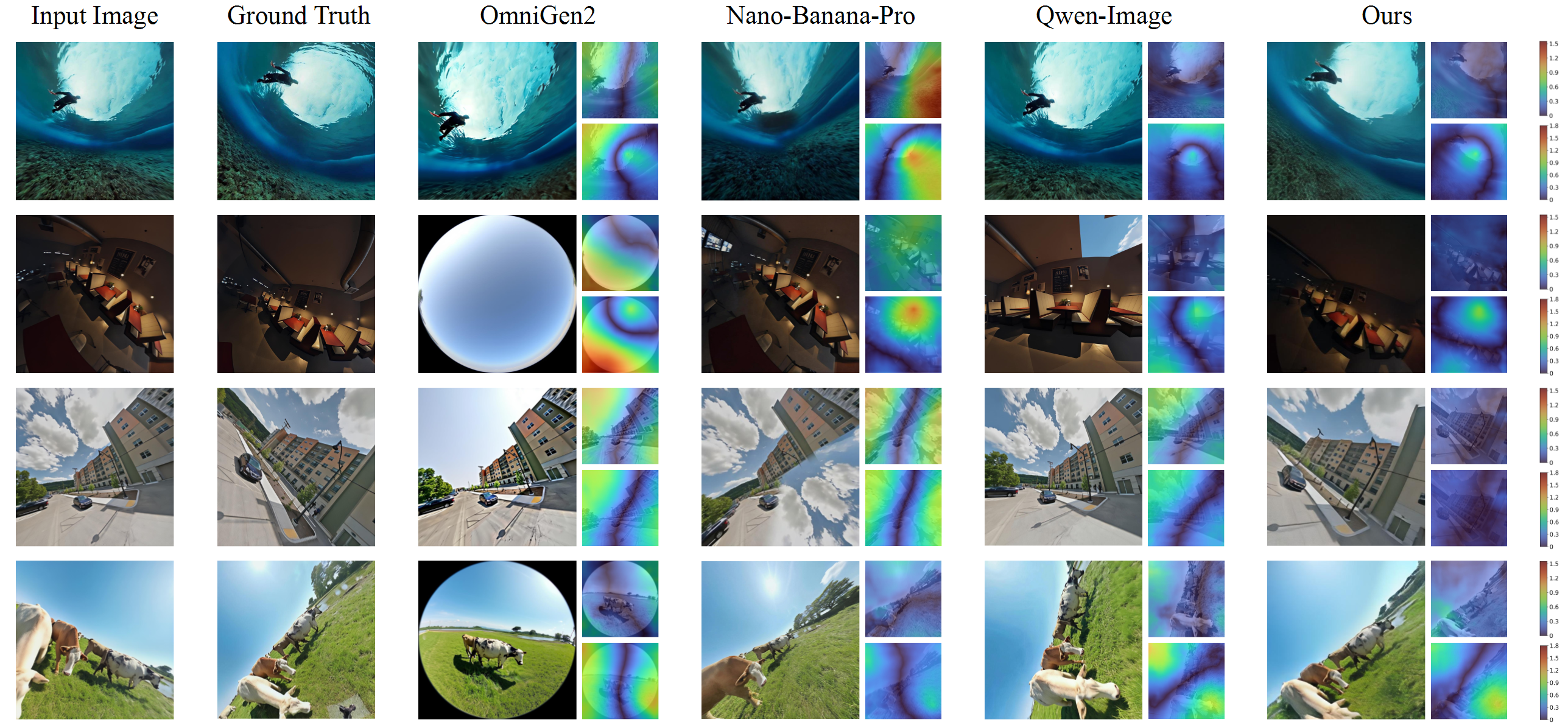
Qualitative comparison part one
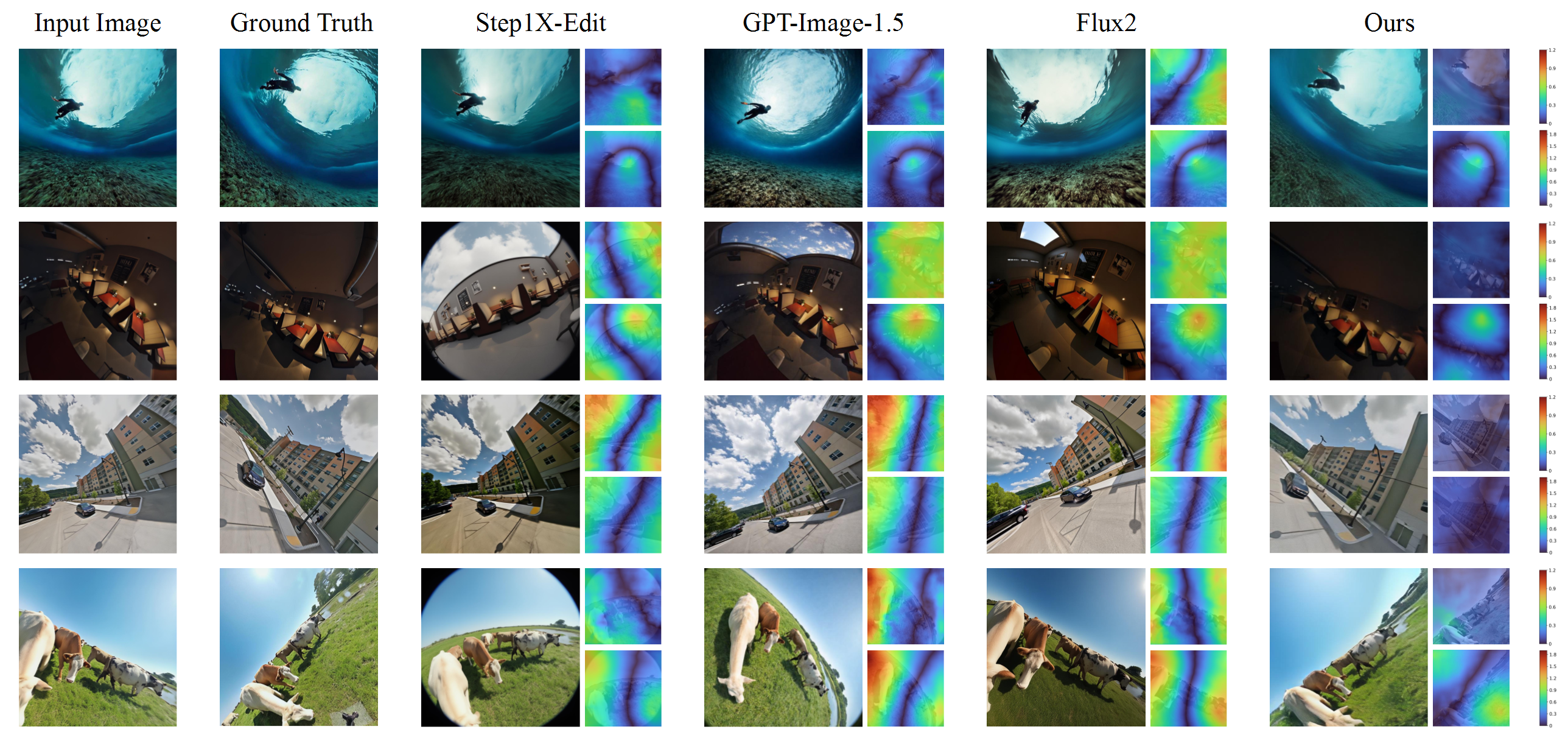
Qualitative comparison part two

Geometric Perception

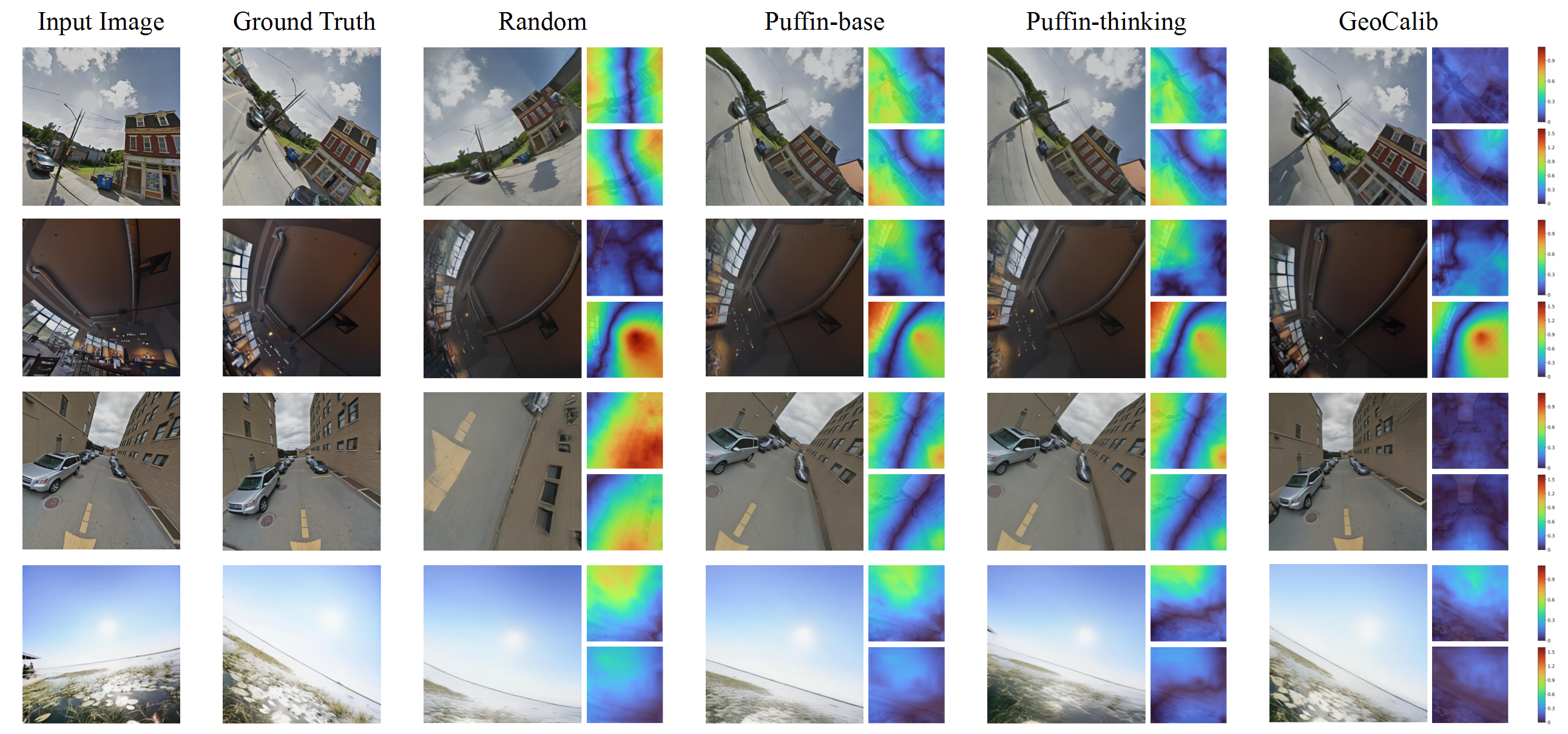
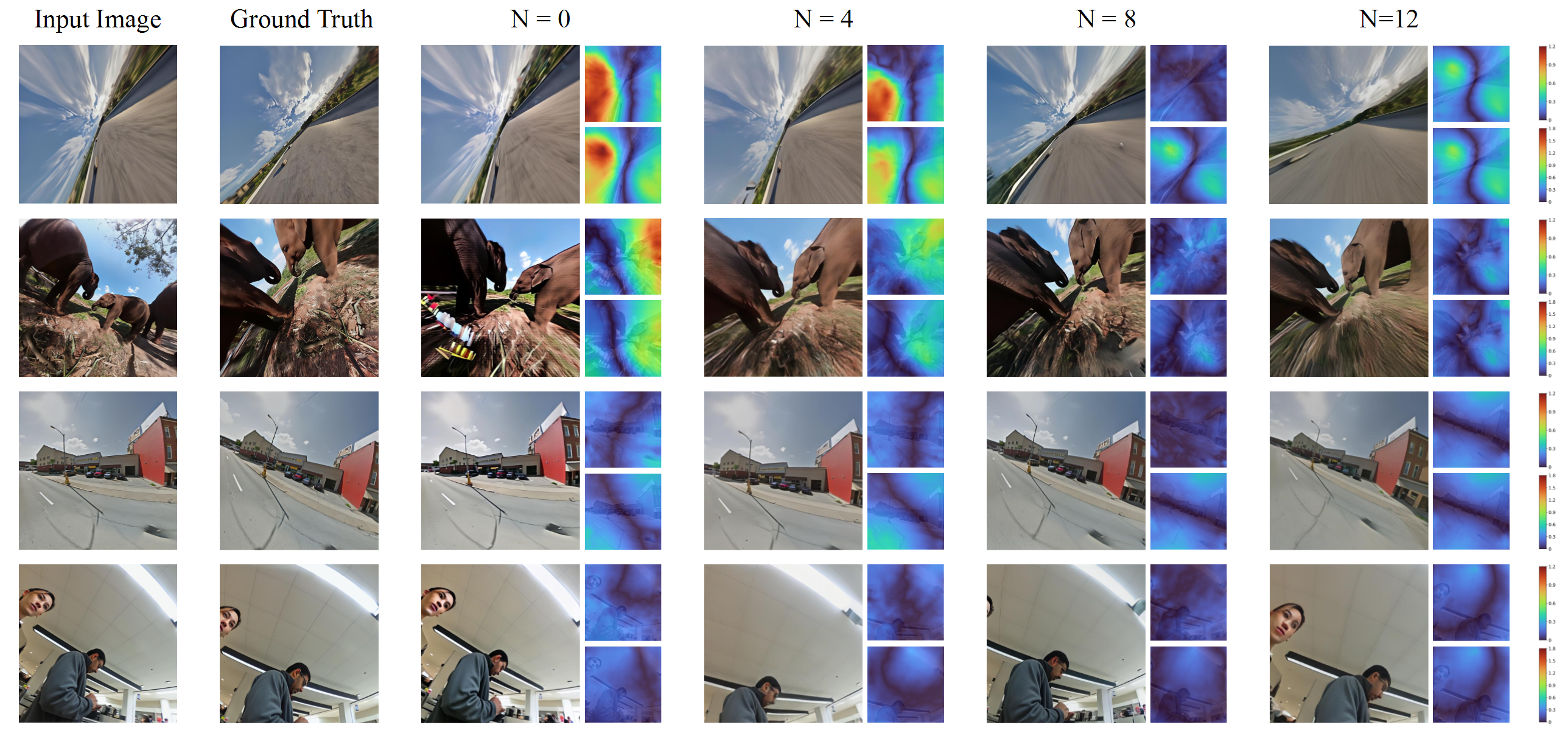
Geometric perception comparison

Chain of Frames

Chain of Frames ablation

BibTeX

@misc{shen2026cameraeditor,
  title  = {CameraEditor: Camera-Controlled Image Editing
            via Video-Prior Sequential Modeling},
  author = {Shen, Xin and Jia, Chengyou and Xing, Keshuo
            and Zhu, Zifeng and Xia, Changliang and Ping, Bowen
            and Dang, Zhuohang and Qian, Hangwei and Luo, Minnan},
  year   = {2026},
  note   = {Preprint}
}